High-Fidelity, Low-Cost Transient Modelling of Steel Reheat Furnaces with Coupled Combustion and Heat Transfer.
This work presents a novel modeling strategy to simulate transient thermal behavior in steel reheating furnaces. It introduces a truncated transient slab model that couples a high-resolution steady-state furnace simulation with a localized, time-dependent domain around a single slab. This hybrid approach drastically reduces computational costs while capturing key phenomena such as skid mark formation, cold spots, and cross-sectional temperature gradients. The model was validated against industrial data from ArcelorMittal and achieved high accuracy. It offers a robust alternative to full-scale transient CFD, making it suitable for optimizing furnace performance and minimizing CO₂ emissions.
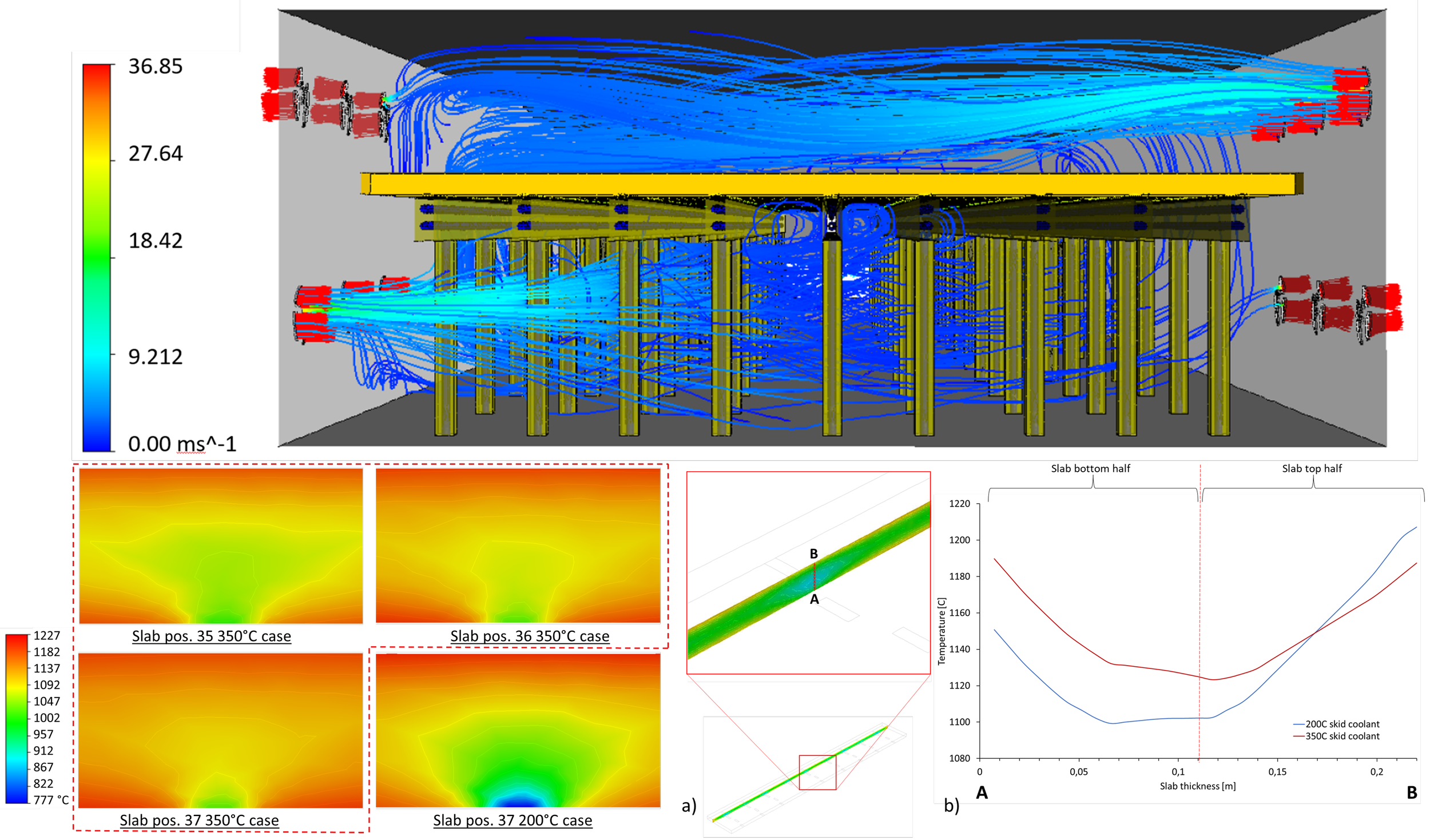
A further application of this model investigates how increasing the coolant temperature of water-cooled skids in a steel reheating furnace affects thermal performance and slab quality. Using a combination of a validated full-scale steady-state CFD model and a truncated transient slab model, the researchers simulated the furnace and slab heating process. The analysis focuses on key thermal phenomena such as slab surface heat flux, cold spot penetration, and skid mark severity. Results show that increasing the skid coolant temperature from 200 °C to 350 °C raises bottom furnace temperatures, improves slab heat flux uniformity, reduces skid mark severity, and shortens reheating time by up to 10 minutes per slab (~5%). This suggests a promising strategy for improving furnace efficiency and reducing CO₂ emissions. The methodology also offers a computationally efficient alternative to full transient simulations, enabling practical optimization of industrial reheating processes.